

This quote is a page from my life. I didn’t write it. I found it buried in a story many decades ago. It’s part of the whole. The whole being my inability to read. I can read. But I can’t (don’t) focus well. I don’t process well. And my retention skills are near to nonexistent. And while others bury themselves in books. Or magazine articles. Or newspapers. I’ll open these up and start “reading” and within moments I am staring at words.
When I’m at a dinner party or in a similar social situation and the subject turns to what folks have read lately, I cringe. My being tries to shrink into an invisible life form that, I hope, no one can see. In times like this I want to disappear. Because I’ve never read novels or news stories, or anything for that matter. But I do often hold book-shaped objects in my hands. This fact about me is one that’s little known. I don’t hide or deny it. It embarrasses me and at the same time, I accept it as part of the human condition, my human condition.
Sometimes, maybe often, well – enough so that I can get at least a small gem with some regularity, the words come to me. They do. The pulled quote is an example. I opened up The New York Times Magazine one fateful day in the middle ’90s and found a story about the artist, Balthus. No, it found me. It’s how I read.
Small chestnuts and I find each other because really that’s how it works here (uses forefinger to point at an area in the head where the brain might be.) And when this happens, I tear the page, rip around the salient points, and touch my heart with it. This is how I deal with so many of the important moments. And then I put the words in a drawer with all the others. Little pieces from many stories. My own lifelong library of soundbites. But just enough (for me) of each to feel like I am learning something. And the above quote has been part of my life story since the words came off the page and into my heart.
In the very same story I cite above, there’s another paragraph that drew me in, and I saved it too:
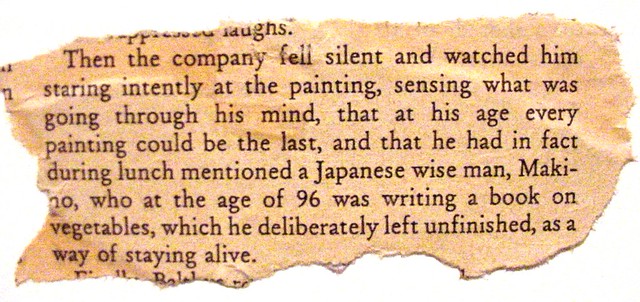
I am neither Makino nor a Japanese wise man, but I understand the reasoning behind leaving something unfinished, if only for the sake of it. I’ve never left a bicycle linger as a way of staying alive, though the concept resonates. I get to a certain point in the making process and, without fail, nod my head as if in agreement with the decades old dilemma I meet regardless of the year or how many units I’ve sent into the world. It can’t get any better. It won’t get any better. So why not take all the energy and start again. That moment of hope. Once again, projecting the idea that it is possible if I just focus. And then it (the focus) dissipates. And I’m left with this emptiness that can only be filled staring at a blank white sheet of paper. Some fifty years of anxiety. Some folks have recurring dreams. I make bicycles and try to get them dialed perfectly from end to end. Away from all this, I know my work is met with open arms. Clients are happy. My reputation is intact. The bicycles are beautiful, and fit their users, and perform well. Somehow that’s not enough for me. And it’s why I live for the time I can start another order. And all it represents.
When I make a bicycle frame, the real action doesn’t begin until I’m a good four hours into the commission. Until then, it’s an intellectual process. I revisit the emails and paperwork that have lived in a folder or on a clipboard – sometimes for years. A mental image of what I plan for the client forms. I grab materials, cut some tubes to length, and verify that my fixtures mirror the very plan I have in mind. All these small tasks are second nature. No formulas. No apps. No molds. Nothing conveniently falls from a tree and becomes the frame or any subassembly of it. At that four-hour mark I grab the torch. It’s like the beginning. Almost but not exactly like the first time, no matter how many thousands of times I’ve been here before. It’s exhilarating. I light the torch to braze the lower head lug – the confluence where the down tube and head tube meet – enveloped by a lug of my own design. I bring the area up to temperature, wait for the flux to turn from a white paste-like consistency into a clear looking liquid that resembles (turn your head if you’re squeamish) mucous. That transition is my cue. It lets me know that the joint is ready to accept the 56 percent silver alloy rod that rests in my left hand as I continually wave the oxy-acetylene torch in my right hand. I’m so used to this moment, so conditioned from decades of making, that often a thought bubble appears over my head in which the words, “Say bye-bye” appear. It’s a sign that the length of brazing rod will soon get shorter and shorter as I fill the joint with molten silver alloy material.
The moment comes and I’ll often remember that scene at Monterey when Hendrix, on his knees, lights his ‘65 Strat on fire and uses body language to coax the flame up and down the neck. With torch in hand I beg the molten filler metal to go where I want it to go. Where it needs to go. Where it belongs. And sometimes I think of lovemaking. I will tease. Lure. Coerce.
Sometimes I even push my way around the joint until it’s filled – but only filled and never one small part of an ounce extra. I know from so many partners and trysts I’ve had at various workbenches in at least two states and three small towns what it takes for this to happen. The brazing rod touches the surface of the tubular steel and flows in and around and from top to bottom. When everything cools (myself included) and when the material solidifies between the interior of the lug and the two tubes nesting within it, and if I’ve done my job well, to borrow a quote from the film Broadcast News, it’s like great sex. Very little I do after this first operation is as satisfying. And I still have the rest of the bicycle frame to braze, to machine threads and bearing surfaces, to do alignment checks, and continually ensure that nothing goes sideways. And then I smoke a cigarette.
To a frame – every single one of them – getting to and then past this first operation with my torch, invariably leaves me empty. I’ve concluded that the lower head lug joint is so important to the integrity of the bicycle that I do this one first. Done well, I know that what’s left in its wake ought to go smoothly. And that the bicycle frame will feel good and have a long life. But very little after this task gives me the same satisfaction. I’m on autopilot for the next few days, brazing this or dressing up that, while trying to imbue all of it with the same love and attention I give to this first area. On some commissions I can sustain the energy almost until I’m done. On others, I can mail it in. For me, it took many years – decades, actually – to be able to do what I have to with trust. I don’t analyze what’s happening in front of me. I just go to my bench and make it happen.
Maybe this is less truthful than it should be. I am leaving something out here. And that is, I have a hard time finishing a frame once it gets to a certain level. It’s normal for me to get past that lower head lug joint, feel all smug and confident about how good my work is, maybe spend another day or two trying to find pleasure at the other end of the frame, and eventually lose interest. It’s not uncommon for me to have a half dozen almost but not quite finished pieces in the shop while I turn my head, grab another pile of stuff for the next name on my list, and start from scratch. That beginning is where the beauty is. Maybe I can nail this one end to end with no gaffes. I live for the exhilaration that comes with possibility. Then it leaves the building. And I leave with it.
I’ve been writing a memoir that isn’t unlike the frames I make. I’ve taken it as far as I could and then walked away. For months I thought I’d be banging out pages and getting closer to when I could look at the lot of it and say, “I’m done.” My interest and energy level have waned. And, not unlike many of the frames I’ve left unfinished just so that I can start a new one, and maybe do a better job of it, the book lingers. I’m a bit lost.
These words have been part of me for most of my time at the bench. I knew early that there was more out there, and I could never find it in my industry. So, I find stories about folks who appear to have reached a level of mastery, and I try to become them.
For a long time, to reach the next level, I got by looking for inspiration. From anyone. Anywhere. Almost. All of it always came from outside my trade. In this book I’ve cited D’Aquisto, and Zeisel, and Laubin, and Nakashima. And others. The narratives surrounding the lives of people like these have been the drivers in my life. There’s a breed of cat whose level of focus and desire strives to make the best possible thing regardless of trends or market share. An oboe. A coffee table. A line of ceramics. I’ve always wanted some of what I thought these makers have, and then use it to bring my bicycles to a higher plane.
I spent an inordinate amount of time looking around, often at the expense of getting work done. An inveterate daydreamer, me. Head buried in magazine articles telling the stories of these people. Watching the same documentary dozens of times. Jiro Dreams of Sushi comes to mind. I’ve seen it twenty times. Looking for someone’s secret. How they stand at the bench. Or talk about their work. And if they talk about their place in their own trade, and maybe contrast their life decisions against other more commercial behemoths whose work is less refined or represents the compromises they refused to make, I’m drawn in even deeper. Are these folks my heroes? My teachers? My accidental mentors? They’re all of this.
But I also realized later in life, perhaps as a fifty something, that it was time to ingest less and live more. Spend more time in my own world, at the bench where folks expected me to make their bicycles the way Paul Laubin crafts an oboe, or how Samuel Zygmuntowicz creates a violin. Or how the others make their own wares. I found myself overflowing with inspiration from and storylines about so many others that I lost track of my own path. In recent years, I’ve looked around far less. And have spent the time since trying to use all the tools that came from decades of wondering about others to make the perfect bicycle. Or at least, the better one. The stories are still embedded in my DNA. As is the inspiration. But I summon them up far less now than I ever did.
We all have these half-truths and little white lies. They’re part of the wall that shields us from reality. Mine began the day I started my label in 1975.
Expectations can be a Hell. But we’re paid to meet them. And when you’re alone with no one left to ask, the questions fuck with your confidence. If you have any. No matter the day. Or decade. Or era. No matter how far along I come on this path I’ve walked for fifty years there’s an unshakable level of doubt when I stand at my bench.
In summoning up as many memories as possible and shoving words together only to rearrange them so many times, it came to me. It’s not the bicycles I’ve been making at all. It’s a life. My own. My way.